
Mobile App Development: Native vs. Cross-Platform in 2026
MA
The Landscape in 2026
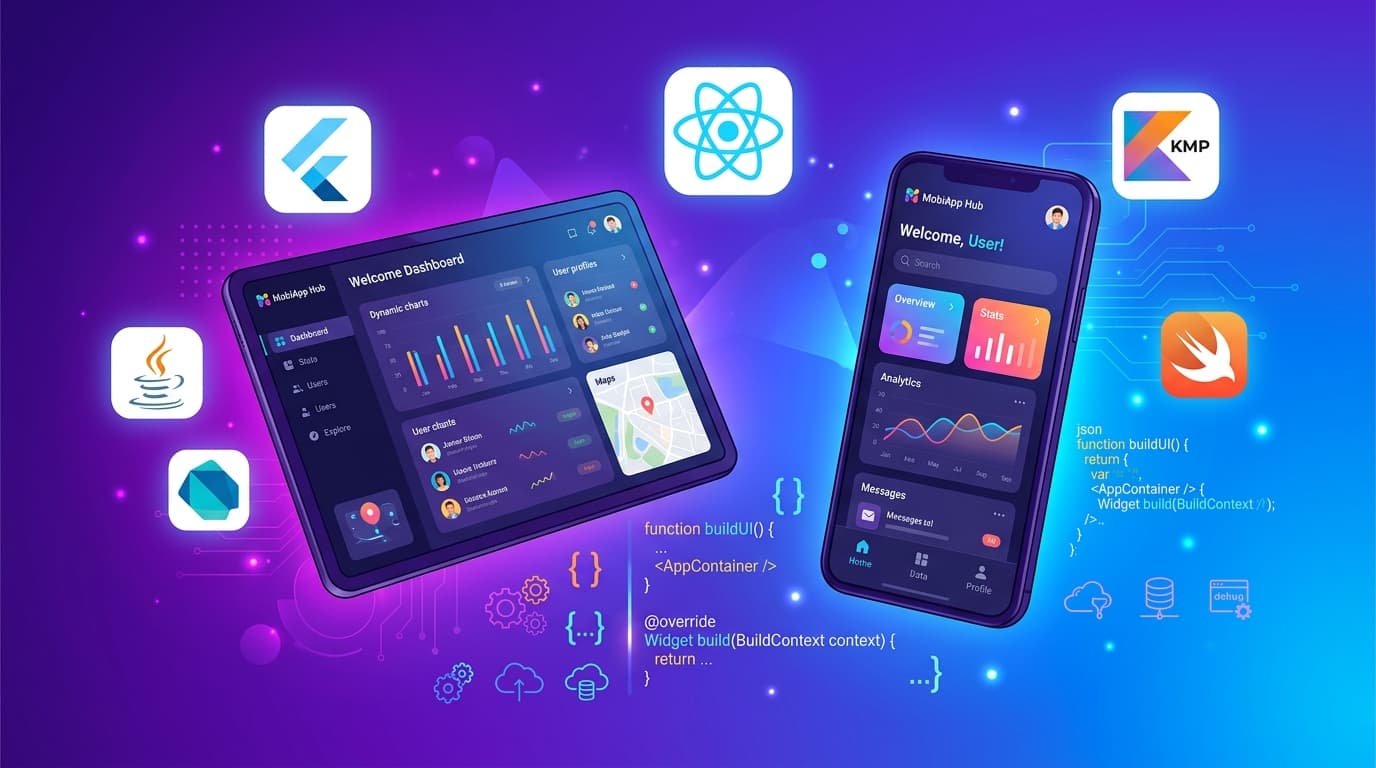
The mobile development ecosystem has matured significantly. React Native and Flutter have closed most of the performance gap with native development, while native platforms (Swift/SwiftUI, Kotlin/Compose) have become more productive with declarative UI frameworks.
So how should enterprises decide?
Decision Framework
Choose Native When:
- Performance is non-negotiable — AR/VR, real-time video processing, or complex animations that must hit 120fps consistently.
- Platform-specific features are core — deep integration with Apple Health, Google Wallet, or platform-specific accessibility APIs.
- You have dedicated teams — separate iOS and Android teams with platform expertise.
Choose Cross-Platform When:
- Time-to-market matters most — a single codebase deploys to both platforms simultaneously.
- Business logic dominates UI — data-driven apps (dashboards, forms, CRUD operations) benefit most from code sharing.
- Budget is constrained — one team maintaining one codebase is inherently more cost-efficient.
- Web parity is needed — React Native (web) and Flutter (web) enable a three-platform strategy from a single codebase.
Performance Reality Check
In 2026, cross-platform performance overhead is typically:
- 5–10 % on CPU-bound tasks (data processing, list rendering)
- Negligible on I/O-bound tasks (API calls, database queries)
- Perceptible on GPU-bound tasks (complex animations, 3D rendering) — but closing rapidly
For 90 % of enterprise use cases, this overhead is imperceptible to end users.
Enterprise-Specific Considerations
- Security: Both native and cross-platform support hardware-backed key storage, biometric auth, and certificate pinning. Cross-platform adds a bridge layer—audit it.
- MDM Compatibility: Ensure your framework plays well with your Mobile Device Management solution.
- Offline-First: Both approaches support offline data sync, but native SQLite access is more mature than cross-platform ORM layers.
- Compliance: Regulated industries should evaluate each framework's HIPAA/SOX compliance tooling.
Our Recommendation
For most enterprise applications—internal tools, customer portals, field-service apps—cross-platform delivers the best ROI. Reserve native for consumer-facing flagship apps where brand experience and platform polish are competitive differentiators.
